
The right entryway decor ideas tell your story before a single word is spoken — and yet it is the room most people treat as an afterthought, letting it accumulate shoes, coats, and unsorted mail until it reads as a bottleneck rather than a welcome. The mild contrarian truth is that the entryway deserves more design attention than the lounge, because it is the first and last space you interact with every day, and it sets the emotional tone for the entire home.
Each of the 14 ideas below balances styling with function — because an entryway that looks beautiful but has nowhere to hang a coat or drop your keys is a failure no matter how good the Instagram photo looks. I have included console depths, mirror sizing, storage solutions, and lighting recommendations alongside the aesthetic direction.
1. Console Table and Round Mirror Entry
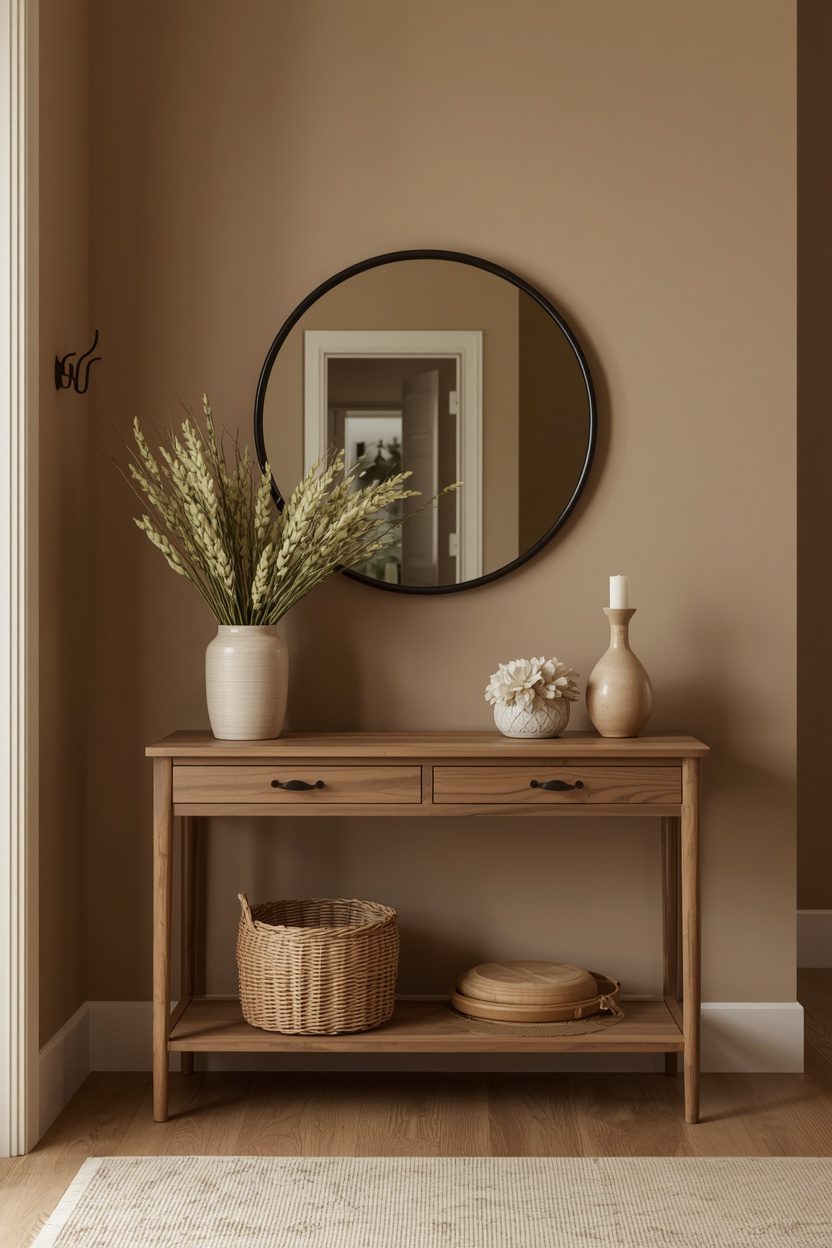
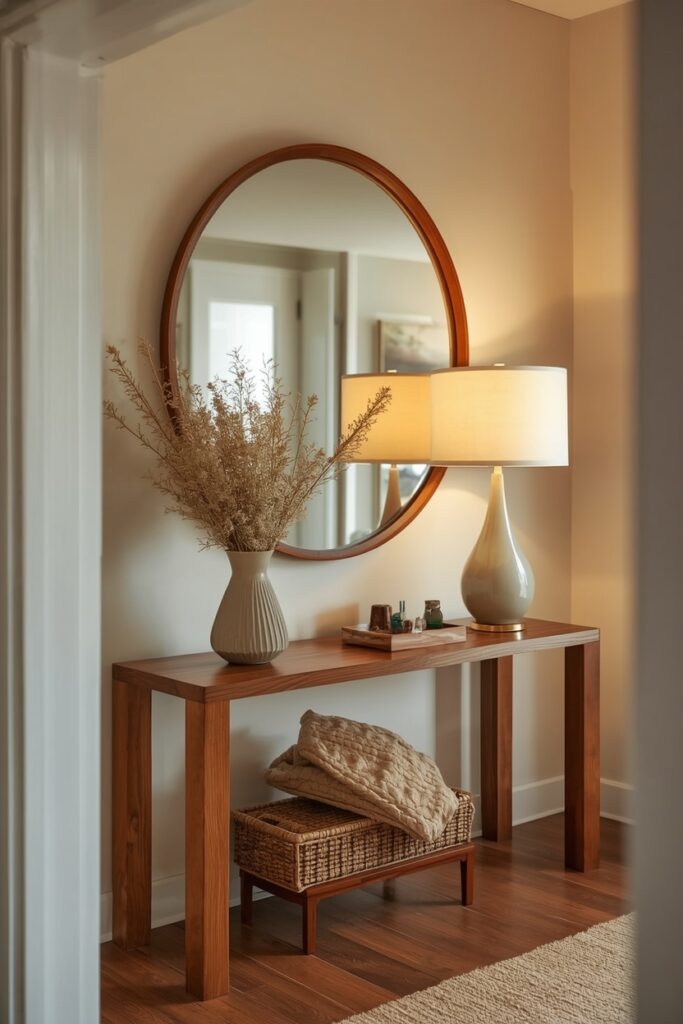
The console-and-mirror combination is the foundational entryway setup, and it endures because the proportions are right: a slim console (30–35 cm deep, 90–120 cm wide) sits against the wall without blocking the walkway, while a round mirror above it reflects light and gives the space depth. Choose a console in warm wood — oak, walnut, or mango — with a shelf or a single drawer for keys and small items. The mirror should be large: at least 60 cm in diameter, mounted so its centre sits at about 150 cm from the floor. Style the console top with three objects following the odd-number rule: a small vase with fresh or dried flowers, a ceramic tray for keys and sunglasses, and a table lamp or a candle for warm evening light.
Below the console, a woven basket holds scarves, reusable bags, or dog leads. This setup suits entries at least 120 cm wide.
2. Coat Hook Rail With Floating Shelf
A row of wall-mounted coat hooks beneath a floating shelf is the most space-efficient entryway storage and it suits narrow hallways where a console table would block circulation. Mount a wooden or metal hook rail at about 150 cm from the floor (accessible for most adults), with 4–6 hooks spaced 15–20 cm apart. Above the hooks, a floating shelf (15–20 cm deep) holds a small plant, a decorative object, and a mail tray.
Below the hooks, a slim bench or a row of baskets manages shoes. Choose hooks in a material that matches your hardware language: brass, matte black, or brushed nickel. This setup works in hallways as narrow as 90 cm and takes only 15 cm of depth from the wall, keeping the walkway clear.
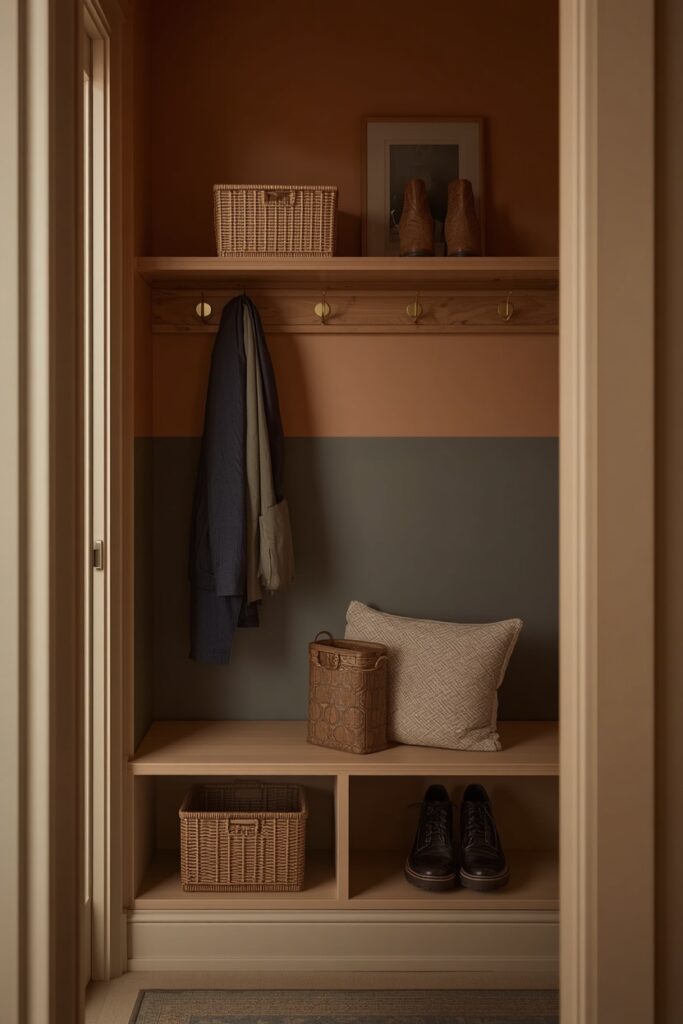
Paint the wall behind the hooks in a slightly deeper shade than the surrounding walls to create a subtle zone definition.
3. Bench and Shoe Storage Entryway
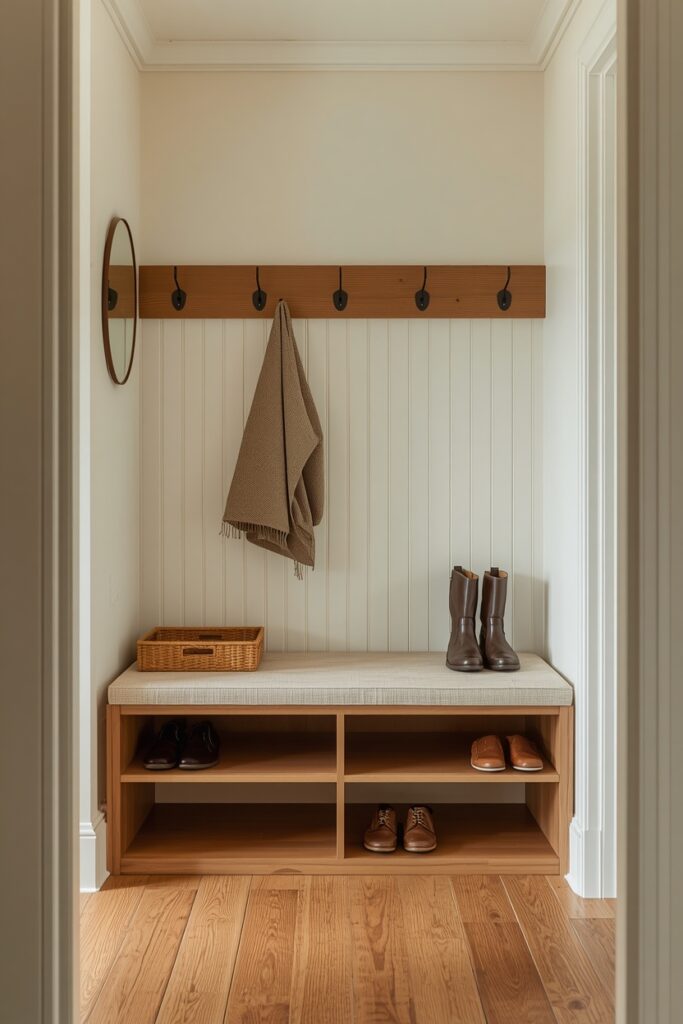
A storage bench — seat on top, compartments or open shelving below — solves two problems: it gives you a place to sit while putting on shoes and a place to store them out of sight. Choose a bench 90–120 cm wide in a finish that coordinates with your hallway furniture. An enclosed bench with a flip-up lid hides the shoes completely; an open-shelf bench keeps them accessible but visible, so tidy pairs are essential. Add a cushion or a sheepskin on the seat for comfort, and mount two or three hooks on the wall above for coats and bags. A small round mirror between the hooks gives you a final check before leaving. This combination works particularly well in family homes where multiple pairs of shoes accumulate daily — the bench corrals them before they spread across the hallway floor. For heavy-use entries, a boot tray beside the bench catches wet or muddy footwear.
4. Entryway Decor Ideas With a Statement Light Fixture
The single fastest way to elevate an entryway is upgrading the overhead light from a standard flush-mount to a fixture with character. A pendant, a small chandelier, a lantern-style fixture, or a sculptural semi-flush mount — scaled to the entry’s ceiling height and width — gives the space a focal point that reads intentionally designed the moment you walk in. For ceilings above 2.5 metres, a pendant or lantern hung so its lowest point clears at least 210 cm suits most setups. For lower ceilings, a semi-flush mount or a wide flush-mount with a decorative frame adds interest without hanging too low.
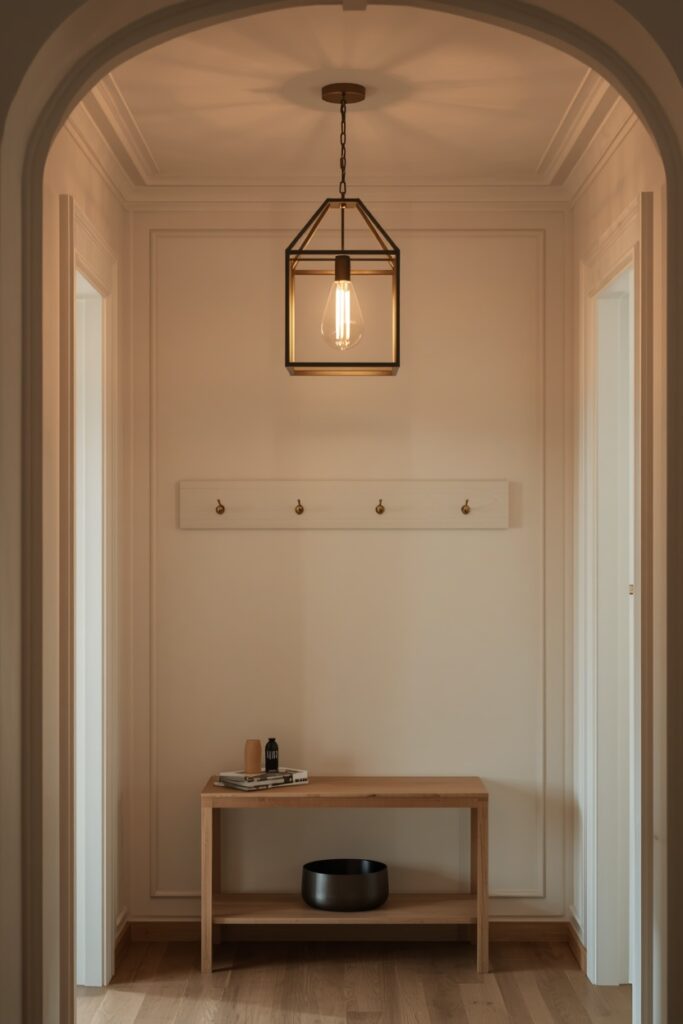
Choose a warm-white LED bulb (2700K) for an inviting glow, and add a dimmer switch so the fixture can shift from welcoming brightness during the day to a soft ambient at night. The rest of the entry can stay simple — a small shelf, a hook, and a mat — because the fixture carries the personality.
5. Gallery Wall Entryway With Narrow Console
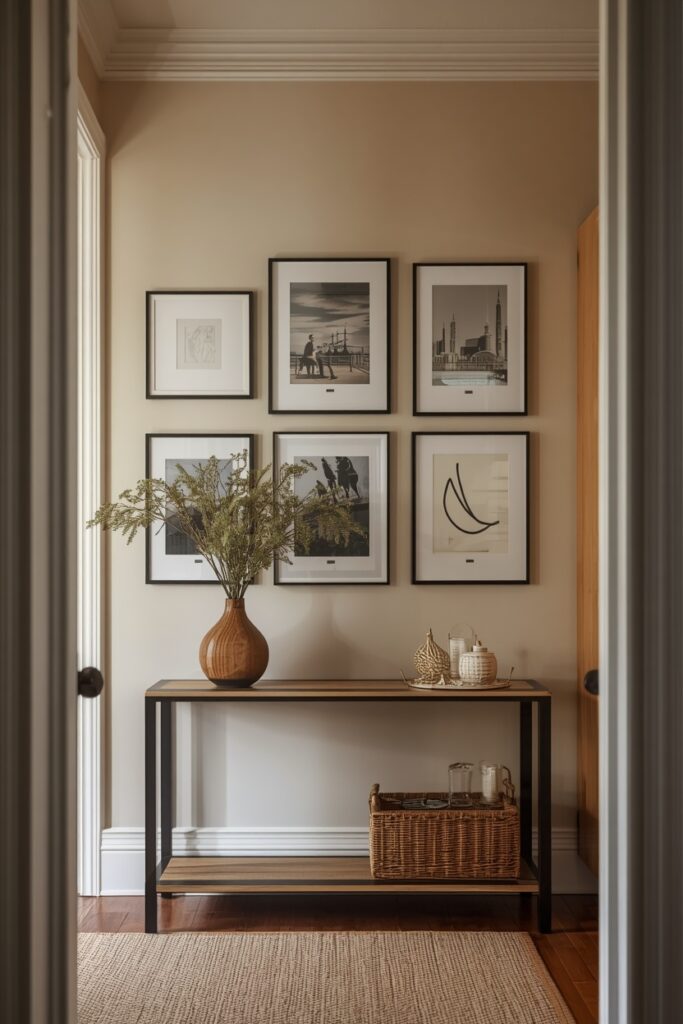
A gallery wall in the entryway turns a pass-through space into a curated first impression. Use a narrow console (25–30 cm deep so it does not block the hallway) and mount a salon-style arrangement of frames above it, extending from console height to near the ceiling. Mix frame sizes but keep the frame material consistent — all black, all natural wood, or all thin brass — for cohesion. Content can be family photographs, travel prints, botanical illustrations, or abstract art in a restrained palette. Space frames 5–7 cm apart and centre the arrangement over the console.
The console top holds only essentials: a tray for keys and a small vase. Below, a single woven basket or a pair of shoes. Lighting should wash the gallery wall: a picture light mounted above the arrangement or a track light on the ceiling pointing downward reveals the artwork and adds warmth to the hallway.
6. Small Entryway With Wall-Mounted Shelf and Mirror
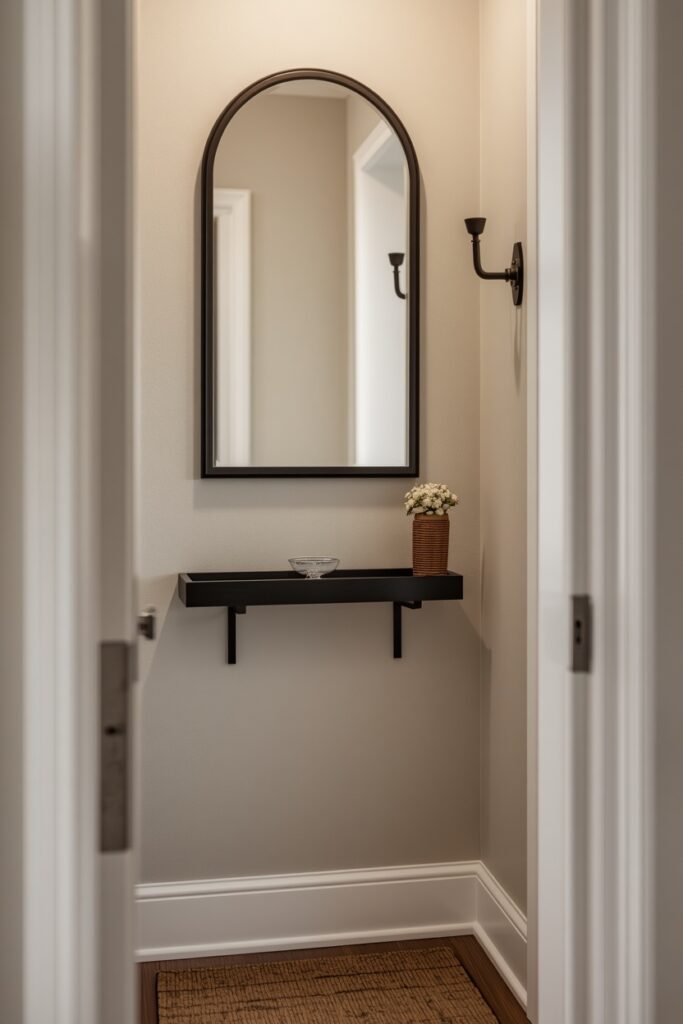
When the entry is barely more than a doorway — under 100 cm of usable wall — a wall-mounted shelf (60 cm wide, 15 cm deep) and a mirror above it are the only pieces that fit. The shelf sits at console height (about 85 cm) and holds a small tray for keys and one decorative object. The mirror fills the wall space above, creating visual depth in a space that has none. A pair of small hooks on the wall beside the shelf holds a bag and a jacket.
Below, a simple doormat defines the threshold. Choose a shelf and hooks in matching material — matte black, brass, or natural wood — so the three elements read as one designed set.
This is a five-item entryway (shelf, mirror, tray, hooks, mat) and nothing more is needed. Paint the small wall section a slightly richer version of the hallway colour to give the zone its own identity.
7. Mudroom-Style Entry With Cubbies
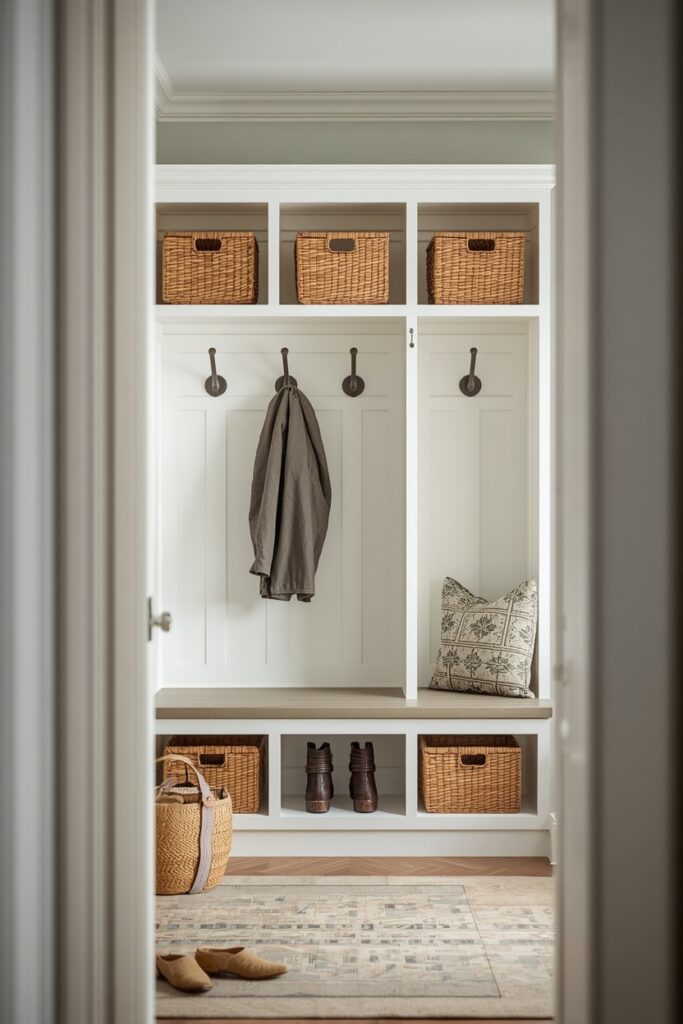
A mudroom setup — individual cubbies for each household member, each containing a hook, a shelf, and a shoe compartment — turns the entryway into a transition station that actually gets used. Build or buy a cubby unit 30–40 cm deep with as many sections as family members (typically 3–5), each roughly 40 cm wide. Mount a hook at the back of each cubby for coats, a shelf above for hats and bags, and a basket or tray below for shoes. Label each cubby with a name tag or a small chalkboard strip. The cubbies can be open-face or fitted with doors for a cleaner look. Position a bench in front if space allows, or use the bottom of each cubby as the shoe compartment. This setup suits entries that open into a wider hallway or a dedicated foyer with at least 180 cm of wall width. It is the most functional entryway solution for families, because personalised storage creates accountability.
8. Modern Floating Console Entryway
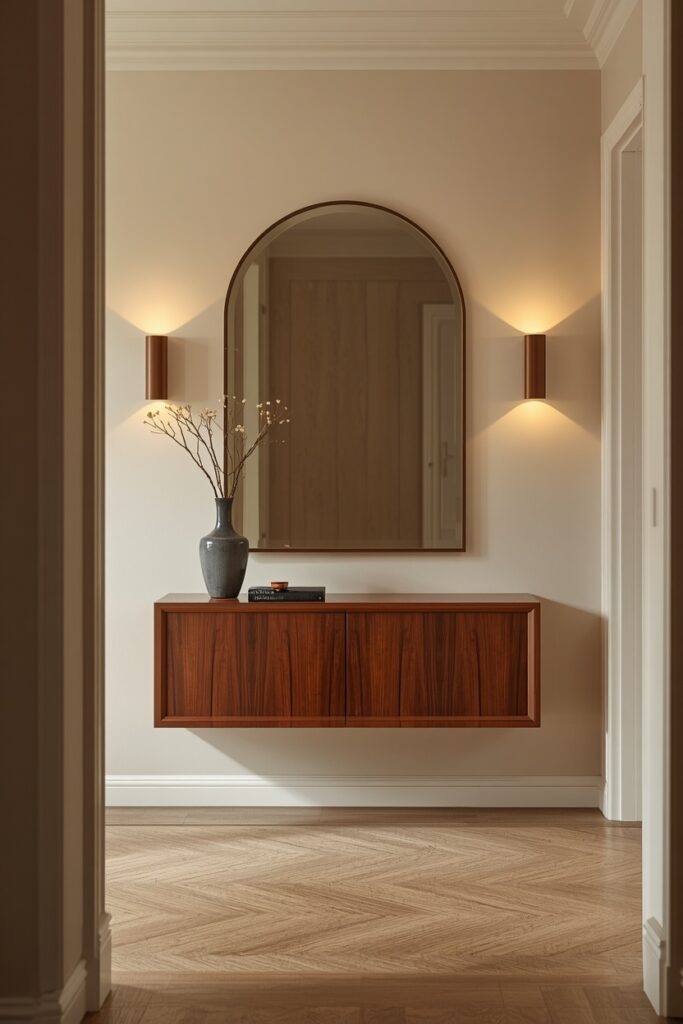
A wall-mounted floating console — no legs touching the floor — creates the same visual space trick as a floating vanity in a bathroom. The console mounts at standard height (about 85 cm) and is typically 90–120 cm wide and 25–30 cm deep. Choose a material that suits your home: matte white for contemporary, walnut for warm modern, or black steel for industrial. The visible floor beneath it makes the entry look larger and simplifies cleaning. Above the console, mount a rectangular or arched mirror. On the surface, keep styling minimal: a tray, a plant, and one personal object.
Below, the open floor can hold a pair of shoes on a tray or stay completely clear. Wire a wall sconce or a pendant above the console for lighting rather than relying on the hallway ceiling fixture, which often leaves entries in shadow. This setup suits narrow entries because the floating profile takes no floor depth.
9. Entryway Decor Ideas With Wallpaper Accent
Wallpaper in the entryway creates maximum impact in minimum square metres — and because the area is small, even an expensive paper remains affordable. Choose a bold pattern: a large-scale botanical, a graphic geometric, or a textured grasscloth. Apply it to one wall — the wall you face when you enter — and keep the remaining surfaces in a coordinating solid paint. The effect is a framed moment of pattern that greets you and your guests without overwhelming the rest of the hallway. Furniture stays simple: a slim console or floating shelf, a mirror, and hooks. Let the wallpaper do the decorative work.
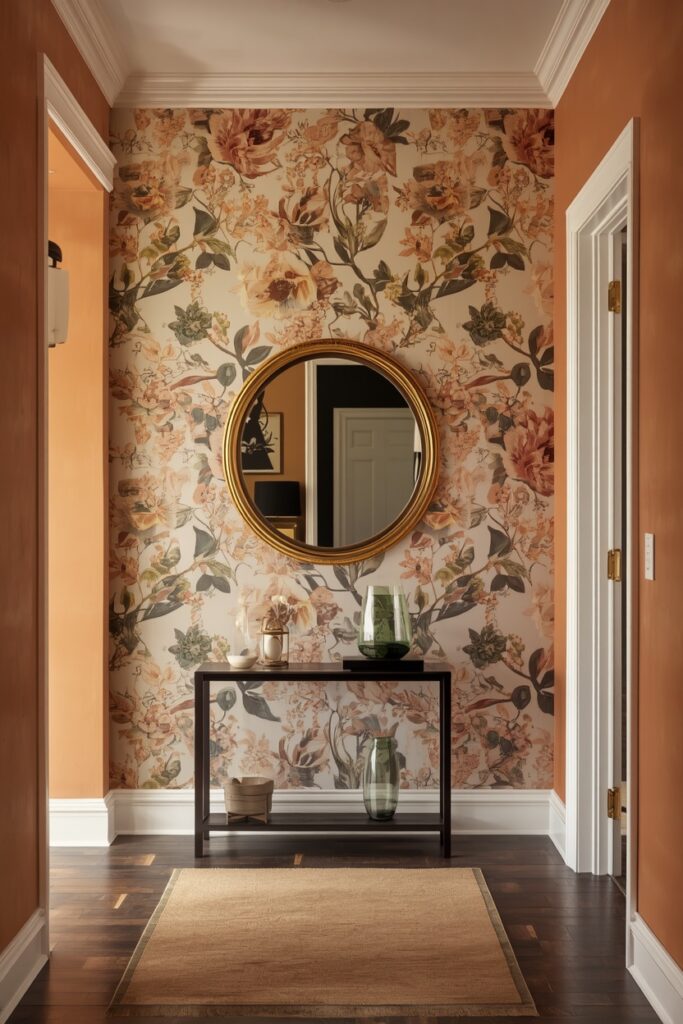
If commitment concerns you, removable peel-and-stick wallpaper offers the look without permanent adhesion, though the longevity is shorter — roughly two to three years compared to pasted paper’s decade-plus. In a rental, peel-and-stick is the practical route. In an owned home, a quality pasted paper is the better investment.
10. Rustic Farmhouse Entryway With Reclaimed Wood
A reclaimed-wood accent wall or a reclaimed-wood bench gives a farmhouse entryway the character that new materials cannot replicate. If the wall treatment is the focus, install reclaimed planks horizontally behind the coat hooks and shelving — the varied tones and weathering patterns create instant warmth. If a bench is the focus, choose a solid reclaimed-timber piece with a waxed or oiled finish, 100–120 cm wide, with cast-iron hooks mounted on the wall above.
Pair with a pair of woven baskets below the bench for shoes and a galvanised metal tray for keys and mail on a shelf above. A vintage-look lantern sconce in matte black or aged bronze provides the lighting. Keep the colour palette to warm whites, warm grays, and natural wood — avoid bright colours, which pull the eye away from the reclaimed material’s natural character.
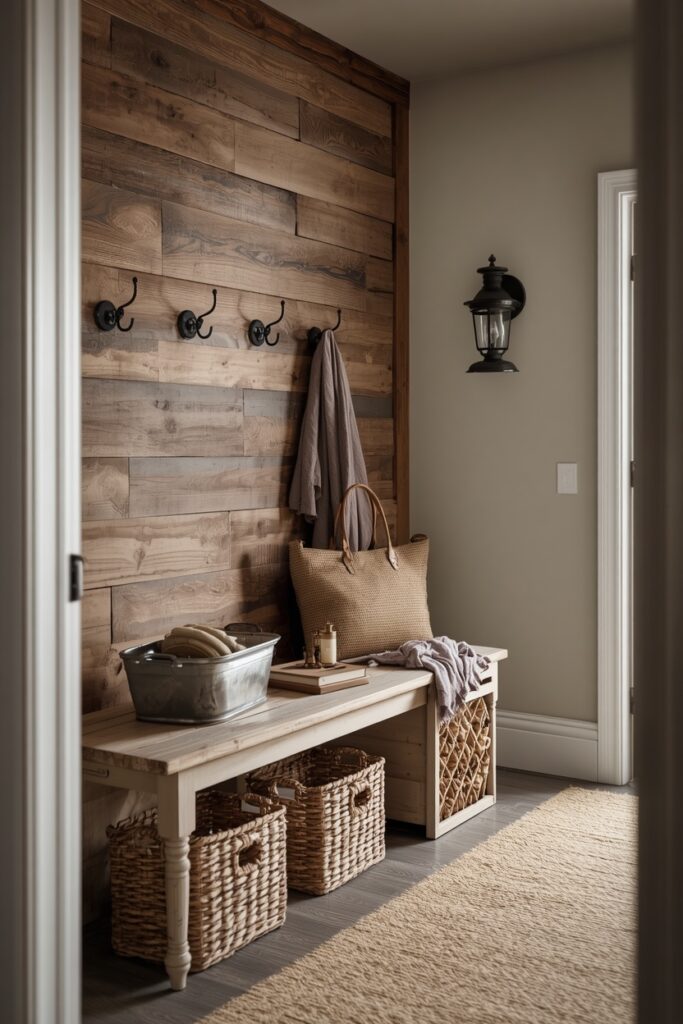
A simple sisal or jute runner on the floor extends the natural-fibre thread.
11. Monochrome Black-and-White Entry
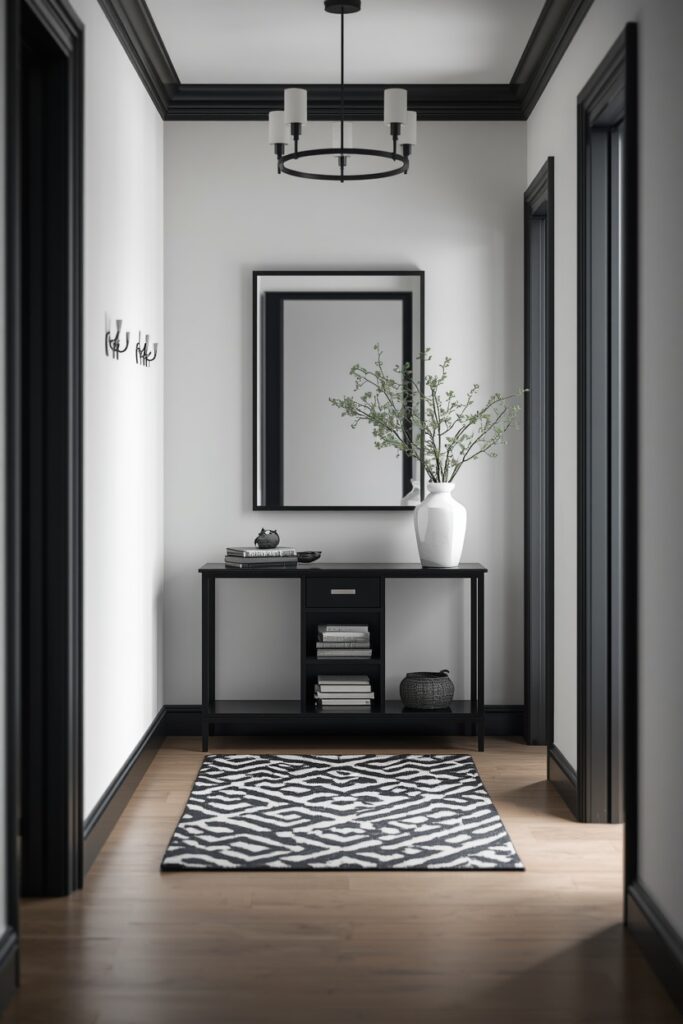
A black-and-white entryway has the graphic impact of a magazine cover and suits both modern and traditional homes depending on the furniture lines. Paint the walls white and the trim, door, and hooks in matte black. Choose a black console table with clean lines — slim metal legs and a glass or stone top — and mount a large mirror in a thin black frame above it. The floor can be a black-and-white checkerboard tile, a dark runner on a white floor, or a bold black-and-white geometric rug. Accessories stay within the two-tone rule: a white ceramic vase with a single branch, a black tray for keys, and a black-and-white print on the wall. Lighting should be a black pendant or a white-shade sconce — either works within the palette. This scheme is striking but demanding: clutter breaks the graphic discipline immediately, so storage must be built in or hidden.
12. Entry With Built-In Window Seat
If the entryway or foyer has a window, a built-in window seat beneath it creates a natural stopping point — a place to sit, look outside, and pause between arriving and entering the house. Build a bench from wall to wall beneath the window, with a hinged seat that lifts to reveal shoe and accessory storage inside. Add a cushion in a durable fabric (performance linen or outdoor-grade cotton) and two or three bolster pillows. The window seat depth should be at least 40 cm for comfortable sitting. On the wall on either side of the window, mount hooks for coats and bags.
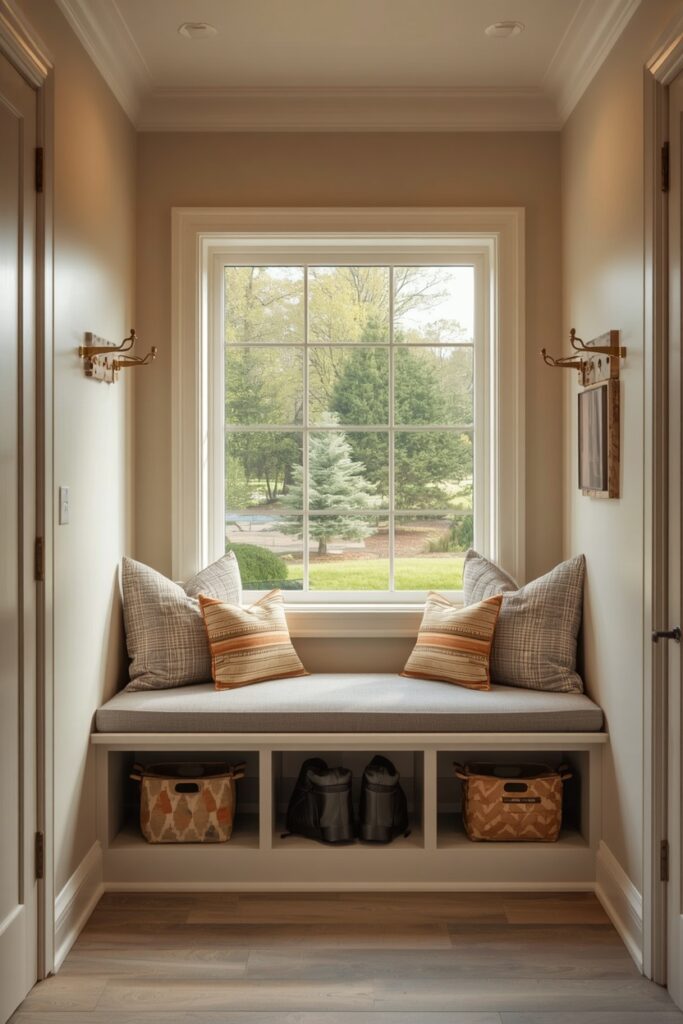
Above the hooks, a small shelf holds a plant or a decorative object. This setup suits wider foyers (200 cm or more) and adds both seating and storage without consuming floor space. The window light makes the entry feel open and welcoming — a natural advantage over interior hallways with no daylight.
13. Layered Rug and Runner Entryway
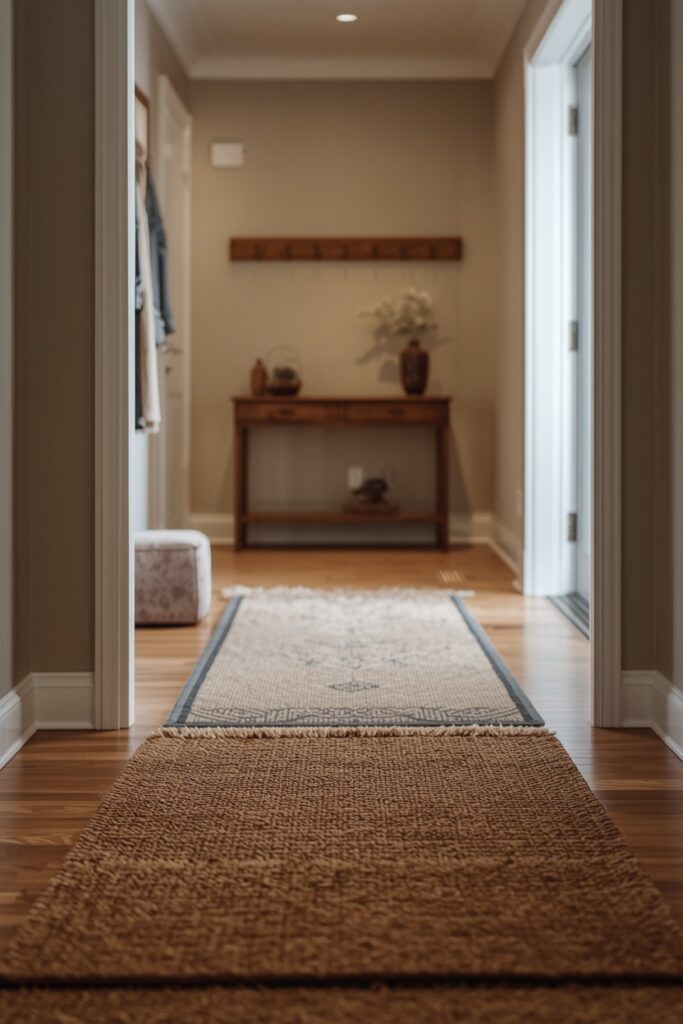
Two rugs — a durable doormat at the threshold and a runner extending into the hallway — define the entryway as a room-length experience rather than a single spot. Choose a doormat in a natural coir or rubber for wiping shoes, and a runner in a flat-weave or a low-pile wool in a colour that complements the hallway walls. The runner should be at least 60 cm wide and extend until the first doorway or turn, creating a visual lane that draws you into the home. Pattern is welcome on the runner — a geometric, a stripe, or a muted Persian — as long as it shares a colour with the surrounding walls or furniture.
This layered approach adds warmth, protects the floor in the highest-traffic zone, and gives the hallway a designed quality that bare floors lack. Secure the runner with a non-slip pad underneath to prevent bunching and sliding, especially on hard floors.
14. Entryway Decor Ideas With a Tall Plant Statement
One tall plant — a fiddle-leaf fig, a bird of paradise, or a tall snake plant in a floor-standing planter — gives an entryway presence that no amount of small decor objects can match. Position it beside the console table, in the corner of the foyer, or next to the front door where it catches light. Choose a planter that suits the room’s style: a woven basket for bohemian, a concrete cylinder for modern, a glazed ceramic for transitional.
The plant should be tall enough to occupy the vertical space between the console height and the ceiling — roughly 120 to 180 cm including the planter. This single element adds life, colour, height, and softness to a space that is otherwise dominated by hard surfaces (floor, walls, door). Pair with a simple console setup — no additional plants needed — so the tall plant reads as the anchor.
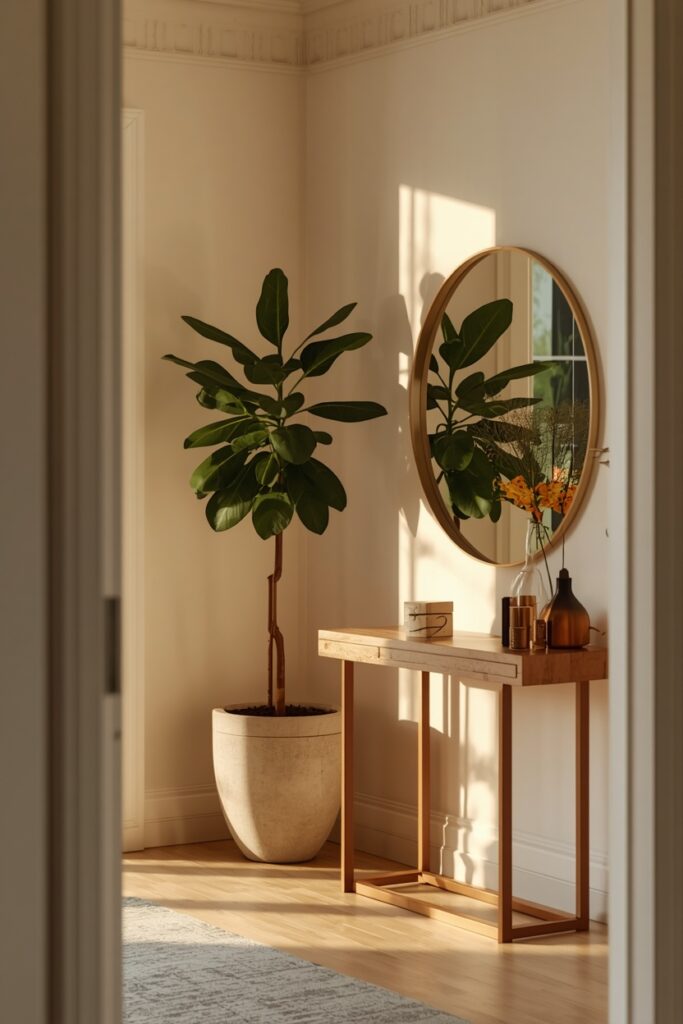
One practical note: entryways often have limited natural light, so choose a shade-tolerant species (snake plant, ZZ plant, rubber tree) if the entry has no window.
Where I’d Start if I Only Did Three Things
If I only did three things, I would start by clearing the floor — get shoes into a basket or bench compartment, coats onto hooks, and mail into a tray so the entry reads as a room rather than a dumping ground. Second, I would mount the largest mirror the wall allows, because a mirror in a typically windowless hallway doubles the light and depth instantly. Third, I would add one warm light source — a table lamp on the console, a wall sconce, or a statement pendant — because the standard hallway ceiling fixture almost always leaves the entry feeling dim and unwelcoming.
Frequently Asked Questions
What entryway decor ideas work for narrow hallways?
Wall-mounted solutions are essential: a floating shelf or floating console (25–30 cm deep), wall hooks rather than a coat stand, and a slim mirror rather than a wide one. A runner rug rather than a rectangular rug keeps the floor visible at the edges, and a wall sconce rather than a floor lamp avoids competing for space.
How do I style a console table without cluttering it?
Follow the three-object rule: a tray for daily items (keys, wallet), a small vase with greenery or dried flowers, and one functional piece (table lamp or candle). Keep the arrangement asymmetric and leave at least a third of the surface empty so the console reads as designed rather than overloaded.
What size mirror works above an entryway console?
The mirror should be no wider than the console and ideally two-thirds its width. For a 100 cm console, a 60–70 cm round or rectangular mirror is the right proportion. Mount it so the bottom edge sits 15–20 cm above the console top to leave room for the styled objects below.
How do I handle shoe storage in the entryway?
A storage bench with enclosed compartments hides shoes fully. A tray or a shallow basket beside the door contains two or three daily-use pairs. A slim shoe cabinet (15–20 cm deep, wall-mounted) stores shoes on an angle and takes almost no floor space. The key is a system that limits visible shoes to two or three pairs at most.
Final Thoughts
Strong entryway decor ideas balance first-impression styling with the unglamorous reality of shoe storage, coat hooks, and key management. Pick one of these 14 designs as your template, adapt it to your hallway dimensions, and invest in the three pieces that matter most: a surface (console or shelf), a mirror, and a warm light source. An entryway that welcomes you home well is worth the same design attention you give to every other room.